















Humanising Language Teaching
Year 2; Issue 6; November 2000

SELF-DIRECTED LEARNING AS A GROWING TREND IN IN-COMPANY EFL
By Matilde Leites and Adriana Butureira
GRB Langauge Services,
Montevideo - Uruguay
The individual decides what he or she's going to learn. Whether it's reading a book, taking a technology-based training program, sitting through a college course or attending a company-sponsored seminar, what you learn is decided by you. Therefore, all learning is self-directed. DAN TOBIN: All Learning is Self-Directed
This quote from a leading company-training consultant illustrates the growing trend to place responsibility for their training in the hands of individuals. Another consultant expands on the subject:
In today's world employees have to be in charge of their learning - no one else knows what tasks they need to be able to perform, or what they need to know to deal with their customers, workers and so on. But it is hard to manage your own learning if you have to wait for a group session led by a trainer.
Technology changes things by putting the learner in charge of their own learning and eliminating their need to rely completely on an outside source. But if learners need to design and learn on their own, they must be able to determine whether they indeed have the skills they need to do their jobs. The most important thing we can do ... is to help people develop their ability to learn and really learn how to learn...
We have to help ... identify what learning and information are needed and then come up with creative ways to provide that knowledge both in isolated situations and in a systematic way.
...almost 80 percent of all training will be Web-based training, whether it's one individual taking information from the Web or a group of people learning with an instructor. Web-based applications allow training to be continuously updated, universalised and tailored. ... Of course there will still be some things that can't be done with technology - teaching leadership skills and handling personnel issues require a small group with a facilitator or a specialist who is able to provide immediate, direct feedback.
Technology's usefulness depends on the planning and design that go into the product but it also depends on the people using it, because ultimately the user can ruin anything... so technology that's very valuable for a particular person may not be valuable if the person refuses to use it or doesn't make any effort to find out how to put it to use.
Michael Marquardt Technology Based Learning: Maximizing Human Performance and Corporate Success
It could be argued that these arguments are too literally extracted from the business world and that EFL requires a more humanistic approach. Melissa J. Bader offers the following insight concerning the use of technology in the classroom in an article published in TESOL:
In an article discussing the link between language learning and computer environments, McLoughlin and Oliver (1998) assert that the computer is a communication tool that can support Vygotsky's (1978) communicative theory of learning. Within this theory, adult-child (teacher-student) interaction is contingent upon the scaffolding of materials within a culturally and socially defined environment. The student-teacher relationship is developed to increase language learning opportunities for the student. Language is integral to the process of scaffolding information, as it facilitates communication and the internalization of material. Research (e.g. Hoyles, Healy & Sutherland, 1991); Mercer, 1994) shows that computer use by students has the potential to enhance collaborative communication and lead to productive language use. Laurillard (as cited in McLoughlin & Oliver, 1998) proposes a conversational framework that is also based on Vygotskyan theory that emphasizes reflective thought and speech as evidence of learning and internalization.
Four essential qualities of communication - discussion, adaptation, interaction and reflection - can be stimulated by computer and teacher interaction. Software that produces learning transactions between teacher, student and machine would be more likely to establish internalization of language characteristics. Nagata (1998) proposes that "computer assisted language instruction, in conjunction with contemporary natural language processing technology, holds out the promise of unlimited, immediate feedback pinpointed to the specific grammatical errors made by the student" (p. 23). If software is capable of producing comprehensible input, increased output and error identification and reduction, it might be argued that such software is likely to contribute to SLA (Second Language Acquisition).
All this theoretical background is more than the foundation, a confirmation for our empirical work with self-directed learning and computer-based training in in-company teaching, an experience that has lately led our own development as a company and as individual teachers in the last couple of years.
As an offspring of the ROI focus that most companies started showing some time ago with regards to their English training efforts, our clients asked us to develop a training model that was teacher-independent.
We have been adapting the original ideas of using software and learner awareness training and have included diverse tools such as learner contracts and their subsequent reviews, and tutoring and monitoring sessions, to suit our various clients' requirements.
All along our insight of the process has also increased, creating an interesting synergy which has spurred even more evolution.
Basically, the system contains the following elements:
1. An initial group session which combines awareness of the new paradigm ("now you are in charge!") and learner training. Companies need to communicate this training paradigm shift throughout the company and find it handy to use our session with that purpose. It is most definitely connected with learner training so it works nicely both ways. The learner training aspects considered are usually learning styles and strategies, as well as time management and needs analyses.
In this session participants are assigned tasks to be accomplished independently where they need to assess and reflect upon their own learning, in this way establishing the foundation of their own learning plans or projects. This works as a loop-input process.
One of the companies we have worked with in developing a self-directed program reinforces the learning-to-learn drive with the use of a learning organiser, which presents varied learning strategies and techniques. The use of this organiser is further reinforced in the tutoring sessions, by helping the learners' reflect upon their work with it.
2. An individual interview in which people are encouraged to analyse their needs (how they are going to use their English), establish objectives (long term desired outcomes), and work out shorter term goals which could contribute to the achievement of their goals. A brief look into their own learning styles and preferred learning strategies helps them shape a list of activities to accommodate their goals into their monthly schedules. They are then required to commit themselves to their projects and to take (in some cases) financial responsibility for their accomplishment.
3. An interactive multimedia software which is the backbone of the system meets some of the requirements of self-directed learning: students work at their own pace, they work out their own schedules and can practice in their place of work.
4. Tutoring and monitoring sessions (both synchronous and asynchronous) are led by "tutors" who provide extra materials, follow-up on activities, give feedback and act as a sounding board for students' reflections on their own progress. They thus provide an environment for "learning and internalization" as suggested by Vygotskyan theory.
5. Optional teacher-led sessions that concentrate on fluency development, conversation practice, and facilitated exposure to real samples of the language. These sessions can also help tailor the content to job-related needs.
The main observations from this process concern both the nature of learning and cultural phenomena related to social development.
- The 5 elements of the program shift control of the process (which is most evident in the use of multimedia software) towards the learner as well as control of the objectives (e.g. initial and individual sessions of personal learning plan development)
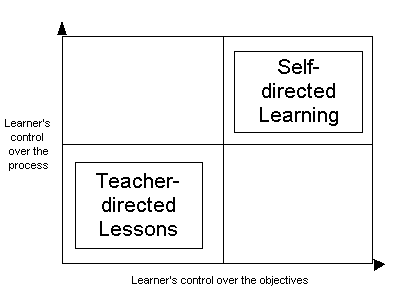
- As students start to feel responsible for their own learning projects, they get to decide on what and how they want to learn. This generates a process of self-awareness, where they begin to reflect upon their goals and desired outcomes. We have usually found that this process is one of discovery, as they seem to be able to describe their objectives and take decisions about them very clearly once they have been helped to focus. This shift in decision-making power, in turn, alleviates the syndrome of putting the blame for their lack of progress on external factors.
Self-monitoring is integrated in the system and students are encouraged to take responsibility for measuring their advances and to develop their own benchmarks. The fact that they set their own criteria for success greatly enhances their feeling of control over their learning process.
- Teacher-led sessions are essential when they provide social interaction and communication skills development. We have found that it is difficult for companies to break with the 'classroom' paradigm and so they will try to turn these sessions into traditionally structured 'classes'. This would create an unnecessary overlap with the 'mechanical language practice' that learners do on their own thus making the teacher-led sessions redundant. It would also leave the learners' communicative and social needs unattended.
- The "new style" in learning appears to suit businesspeople's busy lifestyles and decentralisation trends (such as teleworking). It might actually end up superseding other more traditional "ways".
One of the main advantages of the use of technology is the greater flexibility it provides as a medium both in terms of pacing and location. This important factor is not always perceived by companies, which tend to continue to centralise activities for the sake of control.
- People seem to appreciate the additional choice provided by the flexibility of technology in terms of course design. It has been argued that only 20% of the employees who need training in a specific area would choose to attend instructor led courses. In our programs, we have tried to cater for the various learning styles as well as personal preferences concerning format. This reflects the current trend towards multiple choice in many aspects of our lives. One of the companies we've worked for calls the individual programmes "combos" because the student forms them by various choices from a pre-established "menu".
- Companies need us not only as a pedagogical medium but also as an interface with the varied technological tools on offer. Through planning, design and IT tool selection we provide the framework for a training program suitable for each individual company.
Big Final Question
-Can English (or any language) be learned in this way?
We have very little data to support an answer so far. As the projects develop we hope to collect enough information to attempt to draw some conclusions. Meanwhile, this seems to be the dominant trend with a lot of companies, and we are in the position to have to respond to this need in a professional and pedagogically sound manner.
